Measuring AI visibility: what a percentage really tells you
A dashboard shows 42 percent AI visibility. At first glance, that sounds pretty clear. The brand seems to appear in a good share of answers. Maybe even more often than last month.

But 42 percent of what?
Twenty questions or two hundred? General knowledge questions or real buying decisions? Was it ChatGPT that got tested, Perplexity or Google AI Overviews? And how many times was the same question asked?
The percentage alone answers none of these questions. Even so, people now often treat it as if it were comparable to a Google ranking.
That is understandable. Companies want to know whether they show up in AI search and whether their work is changing anything. For that they need metrics. You just have to understand what those metrics actually measure.
What AI visibility actually means
At its core, AI visibility describes whether a brand appears in answers from systems like ChatGPT, Gemini, Claude or Perplexity.
That can look very different from one case to the next.
Ask for the best providers of a certain kind of software, and the system might recommend five companies. For another question, it may point to an expert article by a manufacturer. Sometimes a brand only comes up in passing within an explanation. And sometimes it does not come up at all.
All three kinds of presence are worth knowing about. They do not carry the same value, though.
A recommendation during a concrete buying decision usually matters more to a company than a passing mention in a general knowledge question. A link as a source, in turn, can show that a specific piece of content was used to answer a question.
That is why it pays to tell brand mentions, recommendations and source citations apart.
If you add everything up, you get a nice-looking number. For marketing decisions, it is often too rough.
The real difference lies in the questions
Picture a manufacturer of heat pumps.
For the question “How does a heat pump work?” its brand does not necessarily need to appear. A neutral explainer may well be the better answer here.
It looks different for “Which heat pump manufacturers are a good fit for an apartment building?” Now the question is about specific providers, products and possibly a later investment.
If the brand is missing from the second question, that matters far more for the business.

Both questions can be part of a visibility analysis. If you weight them equally, though, you mix up two very different situations.
That is exactly why a meaningful measurement starts with choosing the questions. The dashboard comes later.
What problems do potential customers want to solve? What alternatives are they looking for? Which providers do they compare? And at what point in a decision would it matter that your brand shows up?
A good question set reflects these situations. It should not be built from the questions where you already expect your brand to do especially well.
Otherwise you mostly measure how cleverly the test was put together.
Why the same question can give different results
If you work with ChatGPT or Perplexity regularly, you know the effect. You ask a question twice and the two answers differ.
Maybe other providers are named. Maybe a different source comes first. Sometimes only the wording changes, sometimes the whole selection.
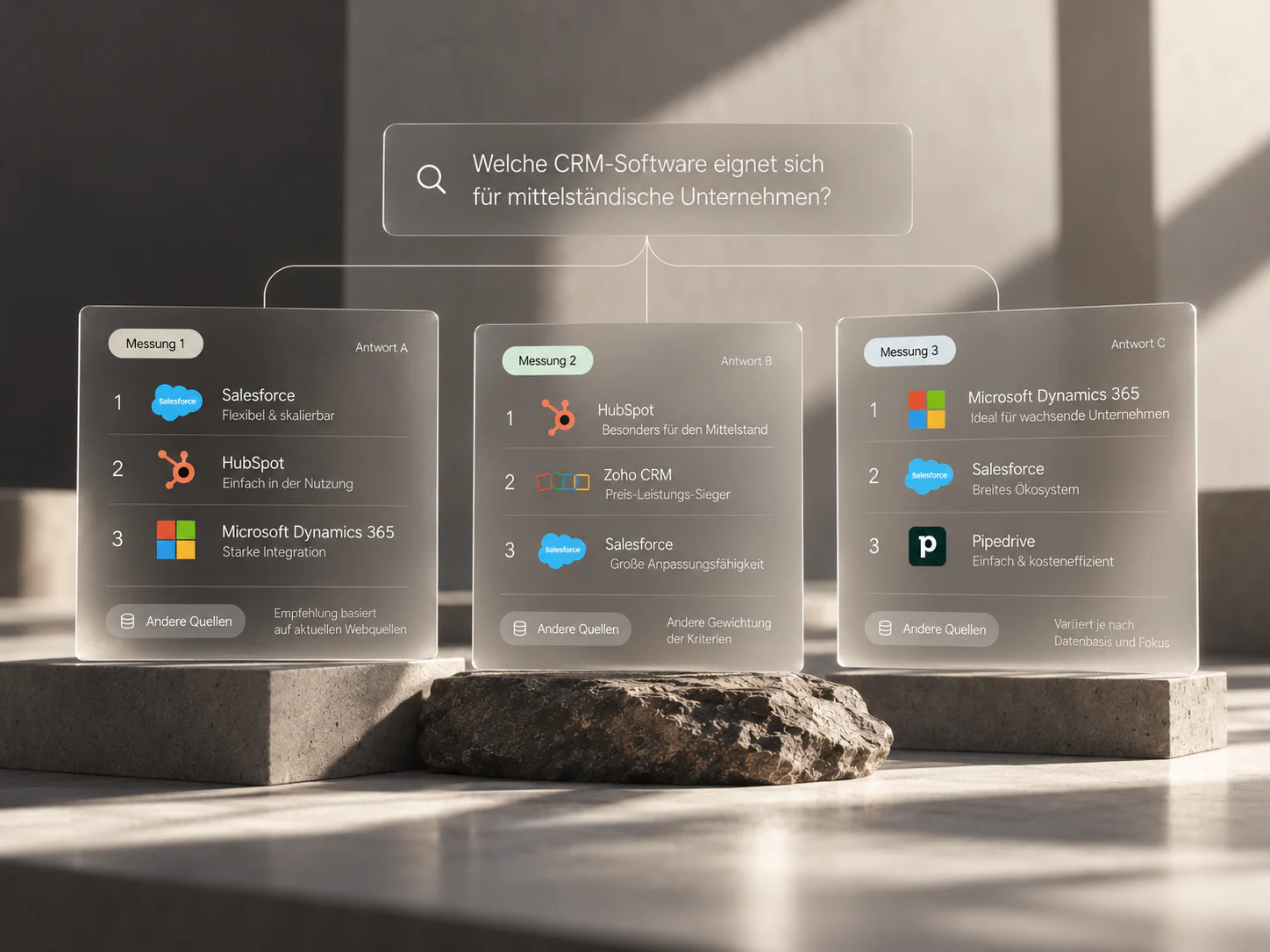
One reason is that generative systems do not always produce identical answers. Model versions, available search results, language and context can play a role as well.
So a single answer is one observation. On its own, it is not solid proof of how visible a brand is.
A scientific preprint from March 2026 looks at exactly this problem. Based on repeated measurements, the study shows that source citations in generative search systems can change considerably. So differences between domains are not automatically proof of real differences in performance.
The consequence is fairly simple. If you want to measure change, check comparable questions several times and document the conditions of each measurement.
That makes the analysis more work. It also makes it far more meaningful.
When an AI Visibility Score makes sense
Despite these limits, a combined visibility score can be genuinely useful.
It can help you follow developments over several weeks or months. That works best when the same relevant questions are checked again and again, under conditions that are as comparable as possible.
What matters is that you can see how the score comes about.
Say a company is named in 12 of 30 questions examined. For this question set, the simple mention rate is 40 percent.
12 of 3040 percent
Simple mention rate for this question set. A hypothetical example.
That is a clear statement and easy to follow. It does not mean the company would be visible in 40 percent of all possible AI queries.
Change the questions, and the score can change too.
So the number describes a result within one defined study. It is no universal property of the brand.
It becomes most useful together with the answers behind it. Which questions lead to a mention? Which competitors are preferred? Where is your own website used as a source? And where is information missing that would matter for a recommendation?
Only then does the metric become a tool that companies can actually work with.
What a good visibility report should show
A report can look simple and still be reliable, as long as it shows what it is based on.
That includes the systems tested, the choice of questions, the measurement period and the language used. Separating mentions, recommendations and citations also makes sense.
A direct look at the answers is especially important.
If a competitor is named regularly, you should be able to see in what context that happens. Is it recommended for its product features? Does it show up in comparison articles? Or does the system just name it because the brand is especially well known?
For the work that follows, that makes a big difference.
A company that lacks technical product information has a different problem from a provider whose product is well explained but hardly appears in relevant comparisons.
Both can lead to low AI visibility. The right fix is different for each.
What companies can actually improve about their visibility
The first impulse is often to produce more content.
It is worth looking at what already exists first.
Can a potential customer tell from the website which problem the company solves? Are the services described in concrete terms? Are the differences from alternatives explained in a way people can follow? Is there solid information on use cases, costs and requirements?
With complex products in particular, these details are decisive.
A manufacturer that describes its machines with technical data, use cases and verifiable results offers a different kind of information than a competitor that mostly talks about innovation and quality.
Then there is the technical side. Content has to be reachable and understandable for search systems. Important information should not sit only in images, animations or closed documents.
In its own guidance, Google points out that the basic principles of SEO still apply to visibility in AI Overviews and AI Mode. You do not need any special AI markup that would guarantee a placement.
Access to public web pages also plays a role for ChatGPT Search. OpenAI describes, for example, how site owners can control access for its search crawler, OAI-SearchBot.
There is nothing secret about any of this. Good information has to meet these basic conditions before it can be found and used at all.
Rising visibility does not automatically mean more revenue
Say a company's measured AI visibility rises noticeably within three months.
That is a positive signal. It shows that the brand comes up more often in the question set being studied.
Whether that brings in new customers is a separate question.
Not every AI answer leads to a website visit. Not every mention is a recommendation. And not every recommendation comes at a moment when someone wants to buy right away.
That is why you should look at AI visibility alongside other metrics. These include organic traffic, qualified inquiries, actual conversions and visibility for questions close to a purchase.
Timing matters too. If visibility improves after new content goes live, that is first of all a match in timing. On its own, it does not prove that the content caused the change.
In young disciplines like GEO, this distinction is especially important.
The better question is where you are missing, and why
A single AI Visibility Score is a good place to start. For the actual work, the gaps behind it are usually more interesting.
For which questions is the competition named while your brand is missing? What information do the systems use to compare providers? And can that information be found on your own website at all?
These are questions you can work on directly.
Sometimes a clear service page is missing. Sometimes a technical explanation. In other cases, credible external sources or clearer positioning can help.
Not every problem can be solved with another blog post.
SEESZN looks at these gaps as part of the Absence Index, among other things. The model examines which relevant questions produce generated answers that leave a brand out. It is an observation model and makes no claim to be an industry-wide benchmark.
That difference matters.
Because in the end, a visibility analysis should show where a brand can still improve, rather than prove how well it is already doing.
And for that you need more than a nice percentage.